
Learning English with the Help of AI: Our Top Apps
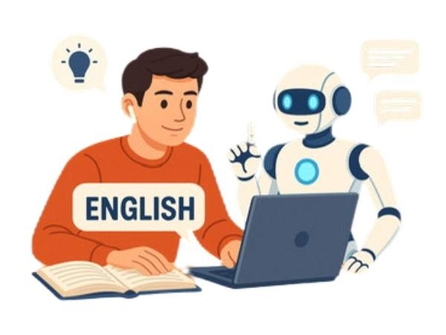
Today, with the total digitalization of our world providing us with countless opportunities, learning English has become much easier and more accessible. Online dictionaries, powerful tools with impressive functionality; online translators that are still not perfect but often very helpful; linguistic apps, and many other resources are now widely available.
In this article, we focus on the use of artificial intelligence in learning English. You may argue that AI is still not perfect either, but honestly, is anything or anyone truly perfect? Artificial intelligence is a great assistant that, when used correctly, can help you acquire new skills or boost your foreign language proficiency.
Let’s start with the most popular AI-powered chatbot. Yes, it’s ChatGPT — an artificial intelligence tool that can effectively contribute to the English learning process. It can help you understand grammar, practice speaking and writing, expand your vocabulary, as well as translate and explain words and expressions in context.

Another popular AI-based chatbot is Google’s Gemini. It can and should also be used to create meaningful, and effective English learning sessions. Just like ChatGPT, it is useful for learning and explaining grammar rules, word meanings, idioms, fixed expressions, and phrasal verbs. It provides examples in various contexts, helps with translation, and instantly generates exercises to practice newly learned material.

Both Gemini and ChatGPT are available 24/7 and provide explanations, examples, and learning materials almost instantly. These virtual assistants can be used at any language level. The key is to formulate the prompts clearly, accurately, and in detail.
However, it is important to remember that AI — whether ChatGPT, Gemini, or any other tool — cannot replace a teacher, does not take emotional and motivational aspects of learning into account, and, yes, … can make mistakes. That is why such tools should be used as supplementary resources, with information verified through reliable sources, and combined with traditional learning methods using textbooks and working with a teacher. This comprehensive approach is what can ensure excellent results in language learning.
Given the widespread adoption of AI-based technologies, we would also like to draw your attention to the following AI-powered apps that can be particularly useful for learning English.
Duolingo tops the list of English learning apps thanks to its gamified and interactive format that motivates users to study regularly. The app adapts to the learner’s level, develops reading, writing, listening, and basic speaking skills, features a simple interface, modular lessons, and mostly free access. At the same time, Duolingo is better suited for beginner and intermediate levels: exercises do not always reflect real-life language, and opportunities for in-depth speaking practice are limited. Overall, it is a convenient and accessible tool that works best as a supplement to other learning formats.
Babbel is a similar app developed by a German team. Babbel focuses on practical language use through dialogues, includes speech recognition, trains pronunciation, and can assess speaking skills. It adapts learning to the user’s level and goals and offers a variety of exercises for mastering grammar and expanding vocabulary. Its drawbacks include a subscription-based model and limited opportunities for free speaking practice. Overall, Babbel is a good choice for learners who want to deepen their grammar and vocabulary in a structured way and learn through realistic dialogues.
Grammarly is an AI-powered application designed to improve English grammar and writing skills. In real time, Grammarly corrects grammatical, spelling, and punctuation mistakes while taking context into account. It helps make texts more accurate, clear, and closer to native-level English by suggesting better phrasing and alternatives without repetition. The service integrates easily with browsers, email, social media, and Google Docs. The free version is suitable for basic checks, while premium features provide advanced style recommendations and plagiarism detection. Overall, it is an effective assistant for improving writing skills, especially at intermediate and advanced levels.

Quizlet is an online platform for effective vocabulary learning and a great example of gamification in education. Easy and user-friendly, it allows learners to create their own word sets or use ready-made flashcards and practice vocabulary through various exercise formats until full mastery. When combined with regular reading, speaking, and writing practice, the app delivers noticeable results in vocabulary expansion. It is most effective for A1–B2 levels but can also be useful for C1 learners studying thematic or professional vocabulary.

Pimsleur is a language app primarily focused on developing spoken English and listening comprehension. It is based on an audio methodology built on gradual repetition and active recall. Learning sessions last about 30 minutes, and words and phrases are repeated at intervals, which contributes to long-term retention. The app offers minimal theory and maximum speaking practice through real-life dialogues, helping learners build confidence from the very first lessons, improve speaking and listening skills, and learn without using a screen — which is especially convenient if you are combining English learning with other activities, such as driving. Its drawbacks include a paid subscription, a limited vocabulary range, and a lack of grammar and writing practice. The app is particularly useful for A1–B1 learners who want to start speaking or improve pronunciation; for higher-level learners, it serves as an excellent additional tool for practicing spoken English.

Although the use of AI and its integration into nearly all areas of life is a clear trend today, which is justified by its many benefits, when it comes to learning foreign languages, English in particular, we still recommend using AI as an assistant and an additional source of practice rather than as the main learning tool. Be sure to try using AI in your language learning journey, but remember that textbooks and a teacher are still a must. If you would like to learn how to effectively use AI, combining it with structured learning and teacher support, we will be happy to help.
Read also:
- Rules of reading in English
- How to quickly learn and memorize English words
- Selection of online English dictionaries and their useful features
Our courses: